


What is the ideal height for hiking or trekking poles?
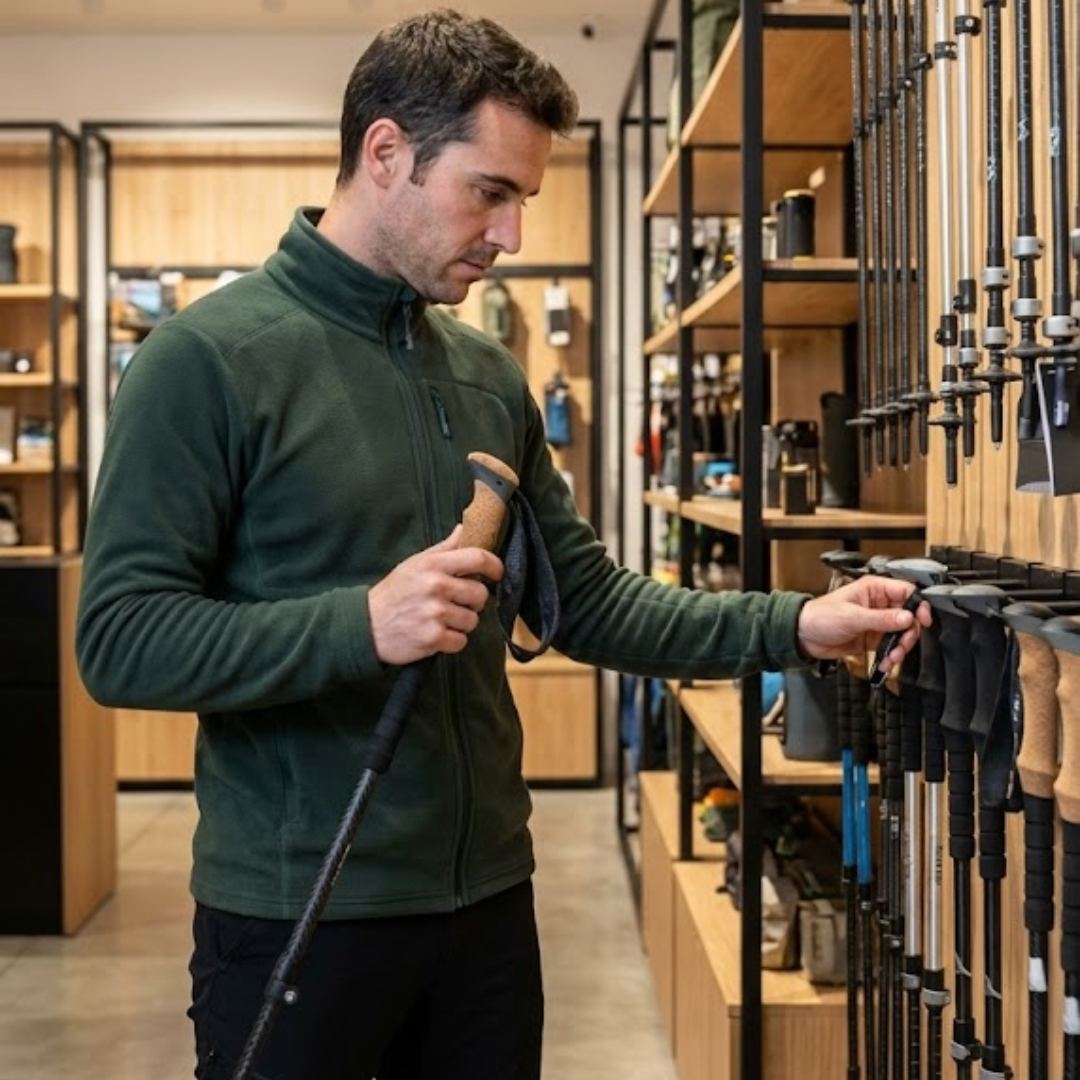
If you're new to trekking or just want to improve your technique, you've probably wondered what height hiking poles you should use. And let me tell you something: choosing the right height completely changes your comfort, stability, and walking efficiency. Today I'm going to explain it to you simply and directly, as if we were packing our backpacks together before heading out to the mountains.
If you don't have suitable poles yet or want to replace them, check out this selection of trekking poles.
Why trekking pole height matters
A pole that's too long forces you to raise your shoulders and tires you out faster. One that's too short makes you hunch over and lose power. When you get the right height for your trekking poles, your body works more efficiently, your knees get a rest, and you maintain better balance on slopes.
Poles aren't just an accessory: when properly adjusted, they become part of your walking technique.
What is the ideal height for a trekking pole?
Here's the important part. Trekking pole height is easy to calculate:
Quick formula:
Your height in cm × 0.67 = approximate pole height
That is:
-
If you are 160 cm tall → 105–110 cm pole
-
If you are 170 cm tall → 115 cm pole
-
If you are 180 cm tall → 120–125 cm pole
Don't obsess over getting the exact number right. What matters is how they feel when you use them: your elbow angle and posture are more important than pure math.
90-degree elbow rule: the most reliable
When you hold the pole vertically, with the tip on the ground near your foot, your elbow should be at approximately 90°. This is how you'll know if the walking pole height is correctly adjusted.
If your elbow is above 90° → the pole is too short.
If it's below → too long.
This rule works for almost everyone, regardless of the terrain.
What height should a trekking pole be for uphill and downhill?
Here's a detail that few people consider: the ideal height changes depending on the terrain.
Uphill
Shorten the length by 5–10 cm.
This gives you more power to push off, without raising your arms too much.
Downhill
Increase the length by 5–10 cm.
This gives you more stability, increases your base of support, and protects your knees.
When you understand what height a trekking pole should be according to the terrain's incline, hiking becomes smoother and safer.
Fixed vs. telescopic poles
Telescopic poles (recommended)
-
Adjust to any height.
-
Change length according to terrain.
-
Ideal for beginners and varied routes.
Fixed-length poles
-
Lighter.
-
More commonly used in trail running than trekking.
-
Only recommended if you already know your exact measurement.
If you want to get the trekking pole height right in all situations, telescopic poles are your best option.
What happens if you use the wrong height?
Many realize it too late:
-
Shoulder and trapezius pain.
-
Premature fatigue.
-
Unbalanced gait.
-
Less power on ascents.
-
Less control on descents.
Properly adjusted trekking pole height is key to comfortable and stable walking.
How to adjust pole height step-by-step
-
Place the pole beside you with the tip touching the ground.
-
Adjust until your elbow forms a 90° angle.
-
Take a few steps on flat ground to test.
-
Adjust + or – 5–10 cm depending on the terrain.
-
Secure the lock so it doesn't slip.
There you have it. Adjusting the height of your walking poles is simpler than it seems, but many people do it wrong by rushing.
Height guide table (quick reference)
|
Your height |
Recommended length |
|
150–160 cm |
95–105 cm |
|
160–170 cm |
105–115 cm |
|
170–180 cm |
115–125 cm |
|
180–190 cm |
120–130 cm |
|
+190 cm |
130 cm or more |
Remember that this is a reference for getting the trekking pole height right. Adjust according to feel.
Extra tips to get the most out of your poles
-
Change tips according to terrain (rubber, metal, snow).
-
On technical terrain, always use well-adjusted wrist straps.
-
Practice coordination: left arm with right leg and vice versa.
-
Keep your poles clean to prevent mechanism blockages.
Good habits turn simple equipment into a powerful tool.
Frequently Asked Questions
Is it bad to use poles that are too long?
Yes, they overload your shoulders and reduce control.
Should children use poles?
Yes, but adjusted to their exact height.
Can I use the same height for the entire trail?
You can, but it's not ideal. Adjusting according to terrain is key.
Conclusion
Now you know what height trekking poles you should use, how to adjust them, and how to adapt the length to the terrain. Well-regulated poles completely transform your mountain experience, tire you less, and make you walk with more control.
If you need durable and comfortable poles, check out this selection of models ready for any trail. Ready for your next trek?