




The Best Skinning Knives (2026)
If your goal is to skin quickly, cleanly, and safely, you need to understand what distinguishes the best skinning knives from a generic hunting knife. This type of tool is optimized for following contours, working subcutaneous tissue with control, and avoiding unwanted cuts to the hide or carcass. In 2026, choosing well means saving time, increasing precision, and enhancing safety with every piece.
Explore our selection of the best skinning knives and sharpening accessories in the store.
What is a skinning knife for and how does it differ from a normal hunting knife?
A quality skinning knife is designed to separate the hide with minimal force and maximum control. You will see pronounced bellies (curves), controllable tips (trailing point or drop point), thin edges, and geometries designed to glide rather than "hack".
A general-purpose hunting knife sacrifices precision for versatility: it opens cavities, cuts branches, or prepares food. It works, but if you're looking for the best skinning knives, a dedicated model gives you:
-
Speed and cleanliness: less rework and less risk of contaminating meat.
-
Real control: tip and belly to stay close to the hide on curves and folds.
-
Safety: less pressure and fewer unintentional "slices" thanks to profiles that support and glide.
Typical (quick) questions:
-
“What is a skinning knife for?” → For precise skinning, following membranes without tearing them.
-
Gut hook, yes or no? → Optional: speeds up opening, but not essential for skinning.
-
Folding or fixed? → Almost always fixed blade: rigidity, hygiene, and speed.
Rule for 2026: if your goal is to skin deer/wild boar/goat with less effort, the best skinning knives outperform any "all-rounder."
How to choose the best skinning knives: blade, size, and steel
Choosing the best skinning knives involves aligning three axes: geometry, dimensions, and steel.
Trailing point vs. drop point vs. clip point
-
Trailing point: large belly and long cutting edge. Excels in broad passes over the hide in curved areas. Requires good control.
-
Drop point: total balance between control and smooth penetration. It's the safe bet for a versatile skinning knife.
-
Clip point: fine and aggressive tip for access and precision cuts; less "forgiving," not the first choice if you're starting out.
Quick rule: if you're looking for the best skinning knives with control → drop point; if you've mastered the technique and want long passes → trailing point.
Ideal blade length (3–4″) and control
For skinning, less is more: between 3 and 4 inches (7.5–10 cm) offers maneuverability without losing traction on flanks.
-
3–3.5″: maximum precision (ears, groin, tail).
-
3.5–4″: better "traction" on long pulls.
Light flat/convex grind and thin edge = superior glide. Jimping on the spine and a discreet stop improve grip.
Recommended steels in 2026
-
420HC: stainless, easy to sharpen, affordable.
-
Sandvik 14C28N: great balance between sharpness, corrosion resistance, and edge retention; ideal "workhorse."
-
CPM-S35VN (and equivalents): high retention and good toughness; requires methodical sharpening and higher cost.
Practical criterion: if you want the best skinning knives without complications → 420HC/14C28N. If you're looking for premium performance and fewer sharpening stops → S35VN.
Ergonomics and safety: handle, textures, and sheaths
An excellent skinning knife is recognizable with closed eyes: it grips and doesn't move.
-
Handles: textured rubber, G10, or micarta for traction with wet hands/gloves.
-
Shape: "palming swell" (slight bulge), pommel that prevents hand slippage.
-
Construction: full tang for rigidity and control.
-
Textures: useful micro-texture; avoids edges that cause fatigue.
-
Sheaths: Kydex or rigid leather with retention, drainage channel, and secure openings.
Essential safety: low angle, tensioned hide (not the edge), thumb on the spine (jimping) guiding the tip. If a handle slips or a sheath wiggles, that model doesn't make the list of the best skinning knives.
2026 Recommendations: our featured skinning knives
Block designed for bottom-funnel attraction. Replace placeholders with your products and link to the store. All of these fit the search for the best skinning knives due to their geometry, steel, and ergonomics.
Value for money option (ES)
Add product – Drop point 3.5″ | 14C28N | G10 handle
Why is it among the best skinning knives for value?
-
Balanced geometry for beginners and advanced users.
-
Edge that quickly recovers with a field steel.
-
Compact Kydex sheath with multiple attachment points.
Specs: 3.5″ blade | 2.8 mm thick | 100–120 g | Full tang.
CTA: See price · Add to cart · Compare
Lightweight option for stalking
Add product – Trailing point 3.2″ | 420HC | Rubber handle
-
Fine maneuvering and long passes on small/medium game.
-
Feather-light and minimalist belt sheath.
Specs: 3.2″ | 2.4 mm | 90 g | Jimping on the spine.
CTA: Check availability · Customer reviews · Pack with sharpening steel
Robust option for driven hunts
Add product – Drop point 4″ | S35VN | Micarta handle
-
Superior edge retention: multiple pieces without resharpening.
-
Full grip handle with anti-slip channels.
Specs: 4″ | 3.2 mm | 150 g | Rigid leather sheath.
CTA: Buy now · See cutting tests · Compatible accessories
Recommended cross-sell: sharpening kits, replacement sheaths, food-grade oil, disinfectant wipes. Link these accessories from each product page to increase conversion and strengthen the "best skinning knives" category.
Quick field maintenance: sharpening, cleaning, and storage
The best skinning knives perform well if you dedicate 5 minutes before and after use.
Before going out
-
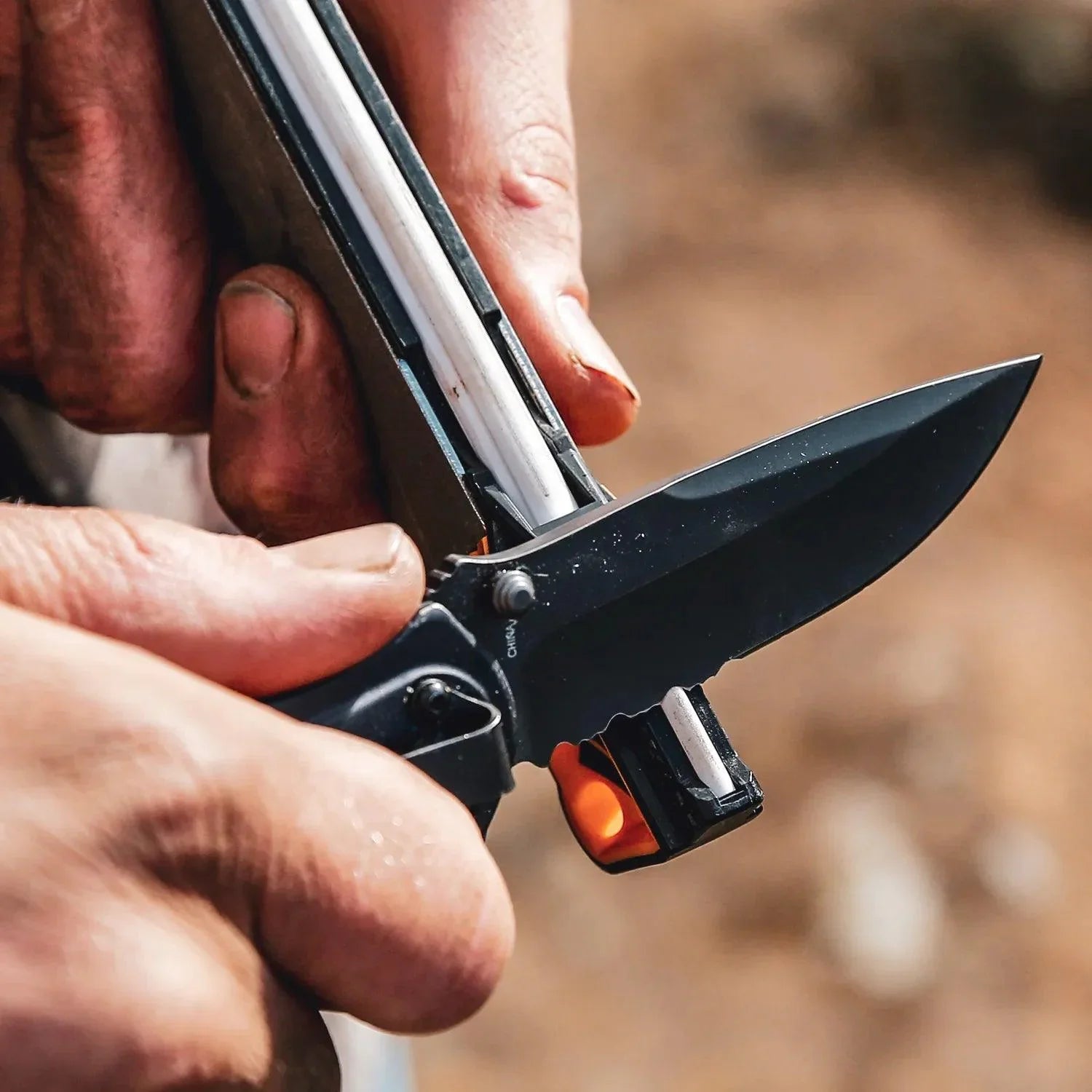
Paper test: if it "tears," 2–3 passes on a sharpening steel or strop with compound.
-
Check screws and sheath retention.
In the field
-
Keep the hide taut and wipe the edge with a cloth every few minutes.
-
If you notice a "burr," use a fine stone (1000–3000) or diamond card: 2–3 passes per side.
Upon return
-
Hand wash with warm water and neutral soap; dry thoroughly (heel and spine).
-
Drop of food-grade oil if the steel is not ultra-stainless.
-
Store dry in a ventilated sheath; if it's leather, control humidity.
Tip: cleaning grease during work + 30 seconds of stropping before storing = much longer edge life (and the best skinning knives always ready).
Frequently asked questions about skinning knives
What exactly is a skinning knife for?
To separate the hide from the meat with precision, utilizing the blade's belly and controllable tip. Minimizes tearing and contaminates less.
What is the ideal blade length?
Between 3 and 4″ for most game; longer reduces control, shorter lengthens the process.
Fixed or folding blade for skinning?
Fixed, almost always: more rigid, more hygienic, and faster.
Trailing point or drop point?
If you're starting out, drop point for its control; if you're experienced and want long passes, trailing point.
What steel is suitable for me in 2026?
For easy maintenance: 420HC/14C28N. For long sessions without resharpening: S35VN (requires more meticulous sharpening).
Do I need a gut hook?
Optional for initial opening; not essential for skinning.
How do I prevent slipping?
G10/rubber/micarta handle, marked texture, and a sheath with good retention. Work at a low angle with your thumb guiding the spine.
Conclusion
If you want the best skinning knives in 2026, prioritize:
-
Geometry designed for precision (drop/trailing),
-
Compact size (3–4″) for maneuvering,
-
Steel suited to your routine (14C28N for balance, S35VN for long sessions),
-
Ergonomics and a sheath that guarantee grip and safety.
From there, choose your path (value for money, lightweight, robust), add it to your cart, and accompany it with a good sharpening kit. The rest is technique, consistency, and edge care. This is how the best skinning knives become your advantage every season.
Discover the best skinning knives and all key accessories in our store now: fast shipping, tested gear, and expert support.