



Hunting Accidents: Causes, Risks, and Prevention
Hunting accidents continue to occur every season in Spain, even though most could be avoided with basic safety measures, organization, and common sense. Each incident not only has serious physical consequences but also legal, personal, and reputational repercussions for the hunting community.
Talking about hunting accidents is not alarmist; it is a matter of responsibility. Safety is an inseparable part of ethical and well-practiced hunting.
Current Situation of Hunting Accidents in Spain
Every year, hunting accidents are recorded, some resulting in serious injuries or even fatalities. Although the total number has decreased compared to past decades, accidents still happen, especially in:
-
Driven hunts (monterías and batidas)
-
Days with poor visibility
-
Poorly organized hunting grounds
-
Situations of overconfidence
Most cases are not due to technical failures, but to human error and the relaxation of basic safety rules.
Safety Equipment that Helps Prevent Hunting Accidents
Accident prevention in hunting does not only depend on experience or compliance with rules. Having appropriate equipment also plays a key role in reducing risks, improving visibility, and reacting better to unforeseen situations in the hunting ground.
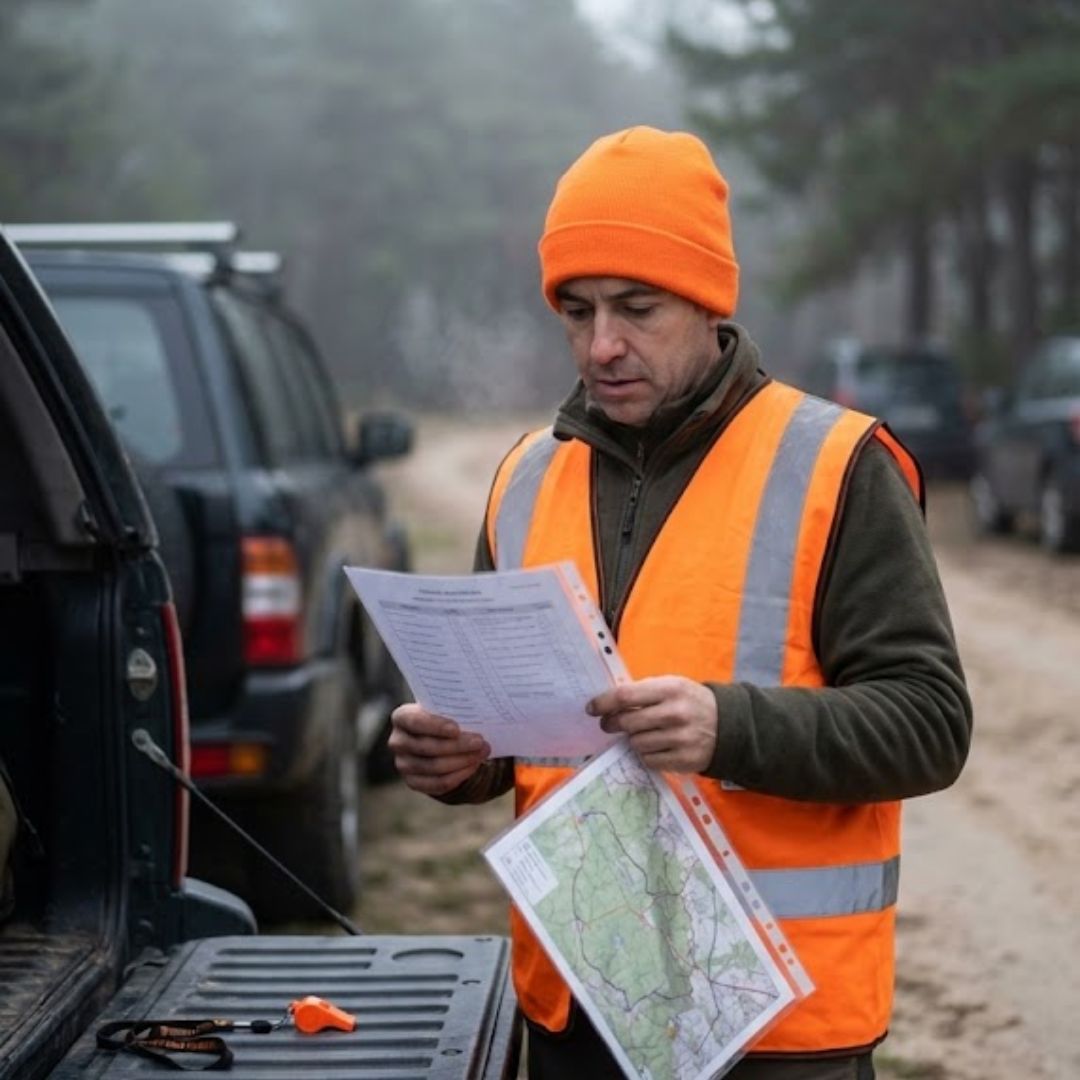
The use of high-visibility clothing is one of the most effective measures to avoid confusion, especially in driven hunts (monterías and batidas) and on days with dense vegetation or low light. Vests, hats, and visible accessories allow quick identification of other hunters and reduce the risk of accidental shootings.
Additionally, carrying functional accessories such as sturdy backpacks to transport equipment in an organized manner, binoculars, headlamps for low-light travel, or technical gloves that improve grip helps maintain concentration and safety throughout the day.
At Young Wild Hunters, we are committed to technical equipment designed for real hunting, with comfortable, resistant, and visible clothing that helps to hunt more safely without compromising mobility or performance.
Why is it a good option for processing game meat?
Its drop point blade offers excellent control for fine cuts, ideal for butchering, separating muscle from bone, and working delicate areas without damaging the meat. It is a balanced knife for both beginner hunters and those with experience in handling game in the field.
The 14C28N steel maintains a stable edge and is easily restored with a sharpening steel, which is key when working on a carcass and more complete sharpening tools are not available.
The compact Kydex sheath, with multiple attachment points, allows it to be always accessible during butchering without getting in the way or contaminating the meat.
The Hunting Simulator as a Tool to Improve Safety
Beyond equipment and rules, continuous training is one of the best ways to reduce hunting accidents. In this regard, the hunting simulator has become a very useful tool for risk-free training.
A simulator allows:
-
Practicing correct target identification before shooting
-
Improving decision-making under pressure
-
Working on managing nerves and reaction times
-
Simulating real hunting situations without danger to people or animals
Especially for novice hunters, but also for veterans, the simulator helps to detect common errors, correct bad habits, and reinforce the importance of not shooting when in doubt.
Integrating this type of training into pre-season preparation contributes to more safe, ethical, and responsible hunting, where the main objective remains the same: to enjoy the day and return home without incident.
The Psychological Factor in Hunting Accidents
One of the least discussed aspects when talking about hunting accidents is the hunter's mental and emotional component. Beyond the weapon, the environment, or the organization of the hunting ground, the psychological state directly influences decision-making and can be decisive in critical situations.
Among the most common factors are:
-
Nervousness when game appears, especially if it appears unexpectedly or in poor visibility conditions. Adrenaline can lead to hasty decisions that, in calmer moments, would never be made.
-
Group pressure, especially in driven hunts (monterías or batidas), where the hunter may feel they "have to shoot" to not let down the team or justify their position.
-
Fatigue after many hours of hunting, which reduces concentration, slows reflexes, and increases the likelihood of making errors in judgment.
-
Overconfidence due to accumulated experience, one of the most dangerous causes. Familiarity with the environment and routine can lead to lowered defenses and relaxed basic safety rules.
Paradoxically, many accidents happen to veteran hunters, not beginners. Novice hunters tend to be extra cautious because they are aware of their limitations, while veterans may become overconfident, believing they "have the situation under control."
The combination of experience, fatigue, and pressure is especially dangerous in the final moments of the day, when attention wanes and more imprudent actions occur.
Basic safety rule: if in doubt, do not shoot. In hunting, missing an opportunity is never a problem; making an irreversible mistake is.
Visibility: One of the Great Silent Enemies
Poor visibility is a determining factor in many hunting accidents:
-
Dense brush
-
Tall vegetation
-
Cloudy or foggy days
-
Sunrise and sunset
Under these conditions, correctly identifying game becomes more complex, and errors multiply. Here, the hunter's high visibility is not an accessory; it is a safety barrier.
High Visibility: Real Prevention, Not Aesthetics
The use of high-visibility clothing drastically reduces the risk of accidents, especially in group hunting.
Clear benefits:
-
Allows identification of other hunters at a greater distance
-
Reduces confusion in dense brush
-
Improves safety during movement
Visible hats, vests, or armbands do not scare game and do prevent tragedies. In modern and responsible hunting, visibility is synonymous with professionalism.
Hunting Ground Organization: Key to Avoiding Accidents
A danger in the hunting ground arises when organization fails. The hunters' skill level doesn't matter if there isn't a clear structure.
Common errors:
-
Poorly marked stands
-
Lack of prior briefing
-
Unannounced position changes
-
Unfamiliarity with the terrain for new hunters
A well-organized hunting ground reduces risk even before a weapon is loaded.
Communication: The Most Undervalued Safety Tool
Many accidents do not occur due to poorly executed shots, but due to unexpected movements.
Good practices:
-
Always announce before moving
-
Confirm colleagues' positions
-
Maintain visual or radio contact
-
Repeat information if there are doubts
Communication saves lives. Silence does not.
Presence of Third Parties: A Growing Risk in Hunting Grounds
In recent years, there has been a notable increase in people unrelated to hunting activities in rural and mountain areas. It is increasingly common to encounter:
-
Hikers using forest tracks or traditional paths
-
Mountain bikers traveling at high speed and in silence
-
Foragers of mushrooms, asparagus, or wild berries
-
Rural residents traveling through nearby farms and paths
Although the hunter is within an authorized hunting ground and on a legal hunting day, the reality is that they are not always alone in the wilderness. Many of these people are unaware of a hunting event or are not fully conscious of the risk they assume when entering certain areas.
This scenario significantly increases danger, especially in:
-
Dense vegetation areas
-
Paths and clearings with poor visibility
-
Low light conditions (dawn and dusk)
Therefore, adequate perimeter signaling, the use of high-visibility clothing, and a consistently cautious attitude are essential to minimize risks. In case of any doubt about the presence of third parties, the only correct decision is not to shoot.
Legal Responsibility: What Many Hunters Underestimate
After a hunting accident, the consequences do not end at the time of the incident. The legal process that begins is usually long, complex, and emotionally very difficult, even when there is no intention to cause harm.
Possible consequences include:
-
Judicial investigation, with statements and expert reports
-
Direct civil liability, even if the accident was accidental
-
High financial compensation, which can affect personal assets
-
Temporary or permanent loss of licenses and permits
-
Criminal proceedings, even without intent or gross negligence
Many hunters who have experienced this situation agree on one point: the psychological and legal impact is often worse than the physical one. Stress, legal uncertainty, and financial consequences can last for years.
This is another reason why prevention must be absolute. In hunting, a single mistake can change a life forever.
Correct Action in the Event of a Hunting Accident
Knowing how to act correctly in case of an accident is also part of prevention. An adequate response can save lives and prevent the situation from worsening.
The basic steps to follow are:
-
Immediately stop hunting activity, ensuring no further risks occur.
-
Secure all weapons, unloading them and placing them in a safe position.
-
Immediately notify emergency services, providing a clear and precise location.
-
Administer first aid only if you have the knowledge, avoiding maneuvers that could aggravate injuries.
-
Do not leave the accident scene, unless expressly instructed by authorities or emergency services.
Improvising, panicking, or trying to hide the situation only makes the consequences worse. Staying calm and acting responsibly is key in these critical moments.