


How to Adjust and Calibrate a Hunting Scope: Steps and Tips
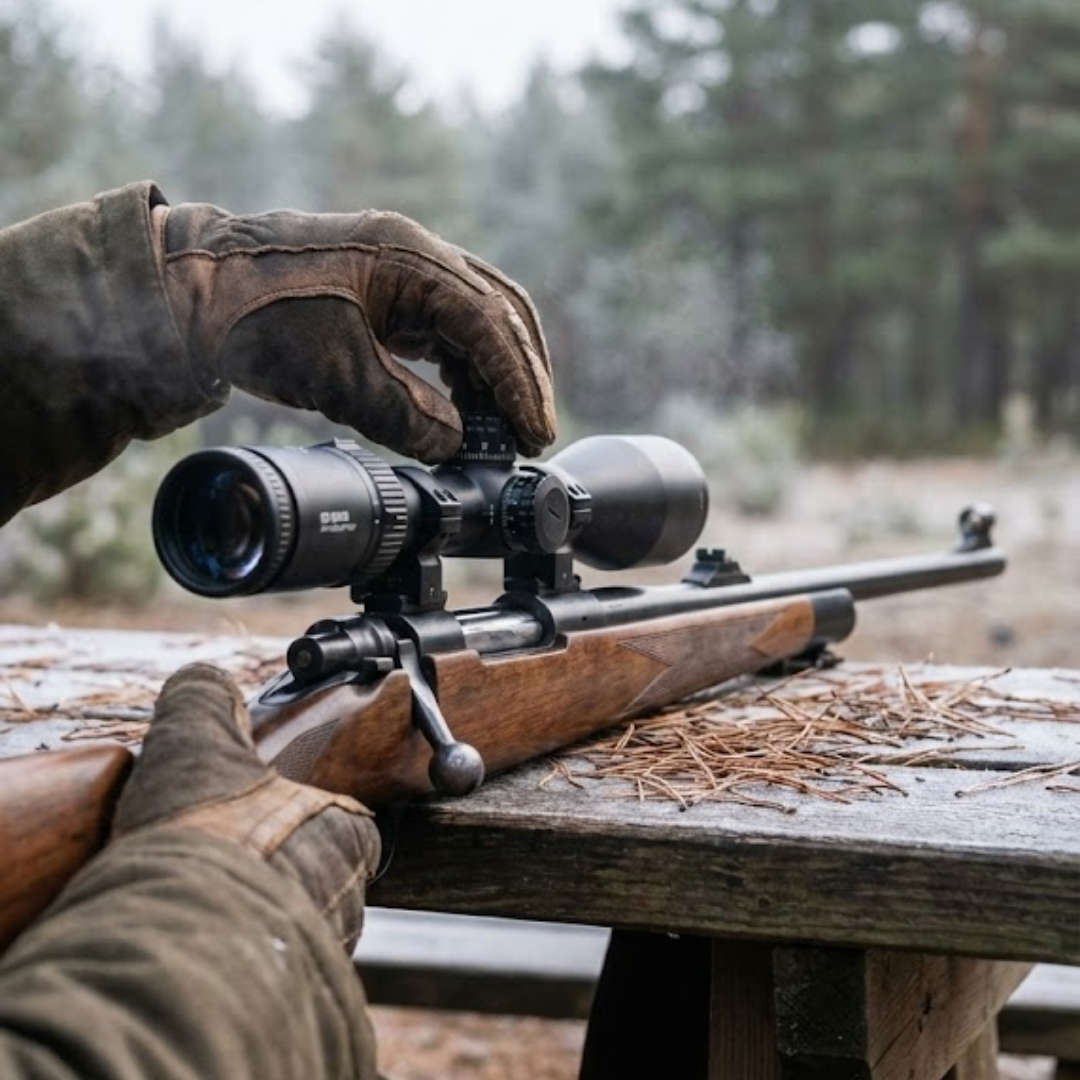
Adjusting a hunting scope is not complicated, but it does require patience, method, and understanding what you are doing at each step. The difference between a poorly adjusted scope and a perfectly adjusted one is, literally, the difference between missing and hitting exactly where you intended. Today, I'm going to guide you through the entire process so you know how to adjust a hunting scope safely, accurately, and without typical errors.
And if you need to upgrade your optics or improve their quality, here is a selection of hunting scopes that work wonderfully for both stalking and driven hunts.
Before you begin: why correctly adjusting a hunting scope matters so much
A well-mounted and well-calibrated scope gives you confidence. It not only improves your accuracy but also allows you to know your weapon as an extension of your body. When you know how to adjust a hunting scope, you start shooting consistently, and that, in real hunting, makes the difference between a clean shot and a failed shot.
How to mount the scope before adjusting it
Before we talk about how to calibrate a scope, you need to make sure it's properly mounted. If the mounting is crooked, loose, or misaligned, nothing we do afterward will work.
Check the following:
-
The rings are tightened uniformly.
-
The eye relief is comfortable and doesn't force you into an awkward posture.
-
The scope is perfectly level, not tilted left or right.
-
The reticle is centered when you naturally shoulder the rifle.
If the base or rings are not correctly placed, you could learn how to adjust a hunting scope a thousand times and it will never be perfect.
How to adjust a hunting scope step-by-step
Here's where the fine-tuning begins. We'll do it simply and without technical jargon, as if we were together at the shooting range.
Step 1: Stabilize the rifle
Place the rifle on a firm rest (sandbag, shooting bench, or tripod). The more stability, the better. Any movement will affect the result.
Step 2: Aim at the center of the target
Make sure the reticle is perfectly aligned with the exact point you want to hit.
Step 3: Take the first shot
Don't adjust yet. Just shoot to see where the bullet lands. This is the foundation for understanding how to calibrate a scope.
Step 4: Analyze the impact
If the shot is high, low, left, or right, that difference will tell you what to correct.
Step 5: Adjust the turrets
Un clic suele equivaler a 1/4 MOA (aprox. 7 mm a 100 m). Cada visor indica su valor.
-
Elevation turret (UP/DOWN): corrects height.
-
Windage turret (LEFT/RIGHT): corrects lateral deviation.
One click usually equals 1/4 MOA (approx. 7 mm at 100 m). Each scope indicates its value.
Step 6: Shoot again
Now, compare. You will repeat this process until the impacts land where you want them.
It happens to all of us: sometimes you think you already know how to adjust a hunting scope, but the second shot tells you that a small tweak is still needed.
What distance to calibrate a scope at
The typical question: what distance should a scope be calibrated at?
The answer depends on the type of hunting, but these are the standards:
-
Stalking: 100 meters
-
Driven hunting: 50 meters
-
Sport shooting or general check: 100 meters
-
Initial calibration: 25 meters (to quickly get the shot near the center)
Personally, I always start at 25 meters to avoid wasting time and ammunition, and then I proceed to calibrate at the actual distance. This way, anyone can learn how to calibrate a scope without complications.
How to calibrate a scope in just 3 shot groups
If you want a quick method, here it is:
-
First group: 3 shots. Don't adjust yet if they are grouped.
-
Second group: correct height and windage by looking at the exact distance between impacts and the center.
-
Third group: confirm. If everything lands within the vital zone at your hunting distance, your scope is ready.
This system saves you ammunition and reduces typical errors when calibrating a hunting scope, such as over-adjusting after a single impact.
Common errors when calibrating a hunting scope
If you want to learn how to adjust a hunting scope quickly, avoid these mistakes:
Calibrating a hunting scope without rushing always yields better results than trying to hurry.
-
Adjusting after each shot without looking for groupings.
-
Not waiting for the barrel to cool between groups.
-
Not holding the rifle steady.
-
Mounting the scope incorrectly from the start.
-
Not noting the actual distance.
-
Not using an adequate target.
How to know if your scope is perfectly calibrated
Once you're done, you should check:
-
That all impacts form a consistent group.
-
That the reticle remains centered without forcing your posture.
-
That there are no strange movements in the turrets.
-
That when you repeat 3 shots, the scope reacts the same way.
When you know how to adjust a hunting scope correctly, you realize that the feeling of precision is almost immediate.
Professional tips for more precise adjustment and calibration
Here are tricks you only learn after many sessions in the field:
-
Always adjust with a cold rifle.
-
Use ammunition from the same batch to avoid variations.
-
Mark the position of the turrets before starting.
-
Adjust only in low-breeze environments.
-
Check everything after a hard shot or an accidental knock.
And very important: a cheap scope, if well calibrated, shoots better than an expensive scope poorly mounted.
Frequently asked questions about calibrating a hunting scope
How often should I calibrate it?
After bumps, changes of rings, changes of ammunition, or at the beginning of each season.
Is a driven hunt scope calibrated the same way as a stalking scope?
The process is the same, but the recommended distance changes.
Does weather affect calibration?
Yes. Heat, cold, and altitude influence trajectory. Always calibrate in conditions similar to your actual hunting days.
Conclusion
Now you know how to adjust a hunting scope accurately, safely, and without losing patience. Adjusting a scope isn't just technique: it's confidence. It's the certainty that when you pull the trigger, the shot will go exactly where it should.
If, after adjusting yours, you think a brighter, more robust, or more precise scope would suit you better, here is a selection of hunting scopes that will accompany you through many years of memorable shots.
Would you like me to also prepare a guide on how to choose magnification, turrets, and reticles according to the hunting modality?