




How to know the age of a roe deer
The roe deer (Capreolus capreolus) is a fascinating species, both for its behavior and its physical evolution over time. Accurately estimating its age is not easy, as each specimen can develop differently depending on its genetics, diet, and environment. However, with careful observation and the combined use of several indicators (behavior, morphology, coat, and especially dentition), it is possible to arrive at a fairly accurate estimate. Below is a detailed guide organized by age range to help you identify a roe deer's life stage.
Roe deer under 1 year old (young and fawns)
During the first months of life, roe deer have very obvious characteristics. They are small, have a slender body, and have a reddish coat with white markings, especially in spring and summer. These markings gradually disappear as they grow. Their behavior is highly dependent on their mother; they remain hidden most of the time and show little independent activity. They have no antlers or signs of rosettes on their foreheads. If you can access their jaws, you will see that they are still fully developing their teeth. Practically speaking, roe deer are rarely mistaken for older specimens due to their distinctly juvenile appearance.

Roe deer from 1 to 2 years old
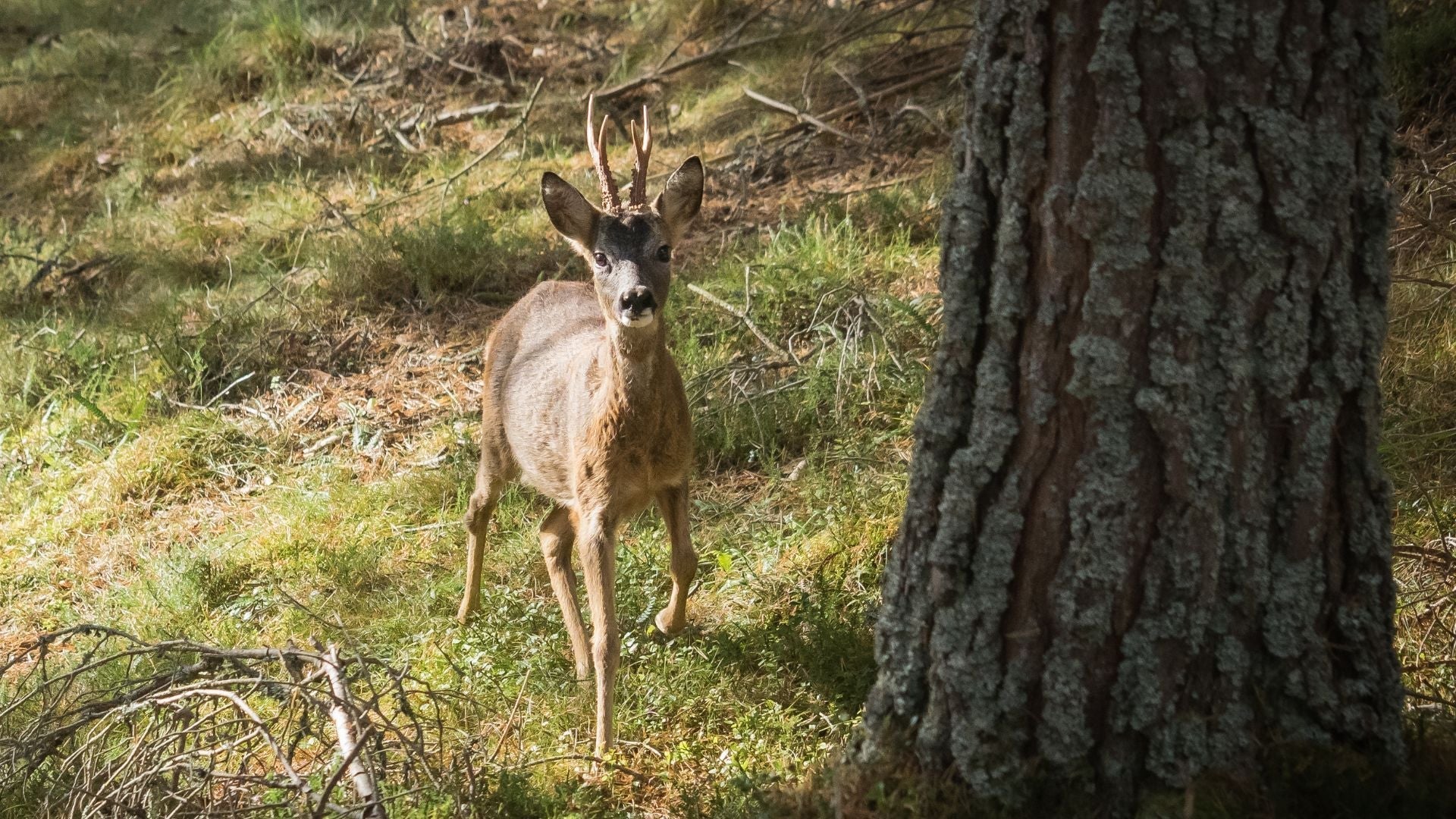
At this stage, the roe deer has already passed the breeding stage, but is still considered a young animal. Its body is more developed, although it still retains a slender build. The antlers begin to appear in the form of buds or small, simple structures, sometimes forked if development has been favorable. The rosettes remain horizontal and barely marked. The behavior of roe deer at this age is usually more innocent and confident. They move more frequently during the day than adults and do not yet display the caution typical of more mature specimens. The coat is more uniform, but the face tends to be dark, especially in the frontal area. Regarding the teeth, the third premolar has three cusps, clearly indicating that the specimen is less than 14 months old, although this characteristic can be observed even slightly later if the tooth replacement has not been completed. The dentition begins to fully establish itself around two years of age.

Roe deer 2 to 3 years old
Roe deer in this age group are in a transitional stage. They are beginning to develop more defined antlers, with recognizable tips and structures. However, these antlers have not yet reached the robustness or volume of adults. The antler tips begin to widen and acquire a slightly larger base, but remain tall. The rosettes remain horizontal or slightly inclined. The body begins to broaden slightly, although the neck is not yet massive. Behaviorally, these roe deer become slightly more cautious, although they have not yet fully developed the instincts of older specimens. In winter, their coat thickens, but the change in fur still occurs relatively early. On the jaw, the third premolar already shows two cusps, and the wear on the molars is very slight, allowing them to be placed with some confidence in this age range.

Adult roe deer from 3 to 6 years old
Here we find roe deer in their physical prime. They have a compact, muscular body, with a wide and massive neck, especially during the rutting season. The rosettes slant visibly to the sides, and the antlers are usually well developed, with low, wide pivots, notable mass, and marked ridges or pearls. Their behavior changes noticeably: they are wary animals, rarely exposing themselves during the day. They usually show themselves during the first and last hours of daylight. The color of the fur on the face becomes grayer, especially in winter, and the frontal fur no longer has the dark tone characteristic of young animals. During the cold months, their fur is denser, and molting is delayed more than in young animals. Analyzing their teeth reveals moderate wear on the molars, although not extreme. This is the most sought-after stage by hunters and photographers, as adult roe deer usually have complete and spectacular antlers.

Old roe deer (over 6-7 years old)
Older roe deer are more difficult to observe in the wild due to their extreme caution. Their build may begin to deteriorate, with signs of weight loss, less firm muscles, and slower movements. The neck remains wide but loses some of its tone. The antlers sometimes regress, becoming shorter or more asymmetrical, although some individuals retain impressive antlers until the end of their lives. The rosettes droop much more, even downward. The winter coat is very dense and takes a long time to change. The color of the face becomes even lighter, accentuating the grayish tone. On the jaw, the wear of the molars is evident: the teeth are flatter and the dental crowns are reduced. This, together with the general physical appearance and extremely cautious behavior, helps to identify older roe deer.

Source: Spanish Roe Deer Association
Identifying the age of a roe deer is not an exact science, but by observing several factors together—such as behavior, antler development, rosette inclination, coat coloration, and, above all, dentition—it is possible to estimate with relative precision what stage of life it is in.
Author: María Balletbó