




On the hunt for "the lady of the forest".
La becada es un ave migratoria con muchas peculiaridades que la hacen muy especial entre sus parientes más cercanos. Es la única especie de limícola que está más ligada a hábitos terrestres que acuáticos, a diferencia de otras aves fangosas o fangosas como los zarapitos o los playeros.
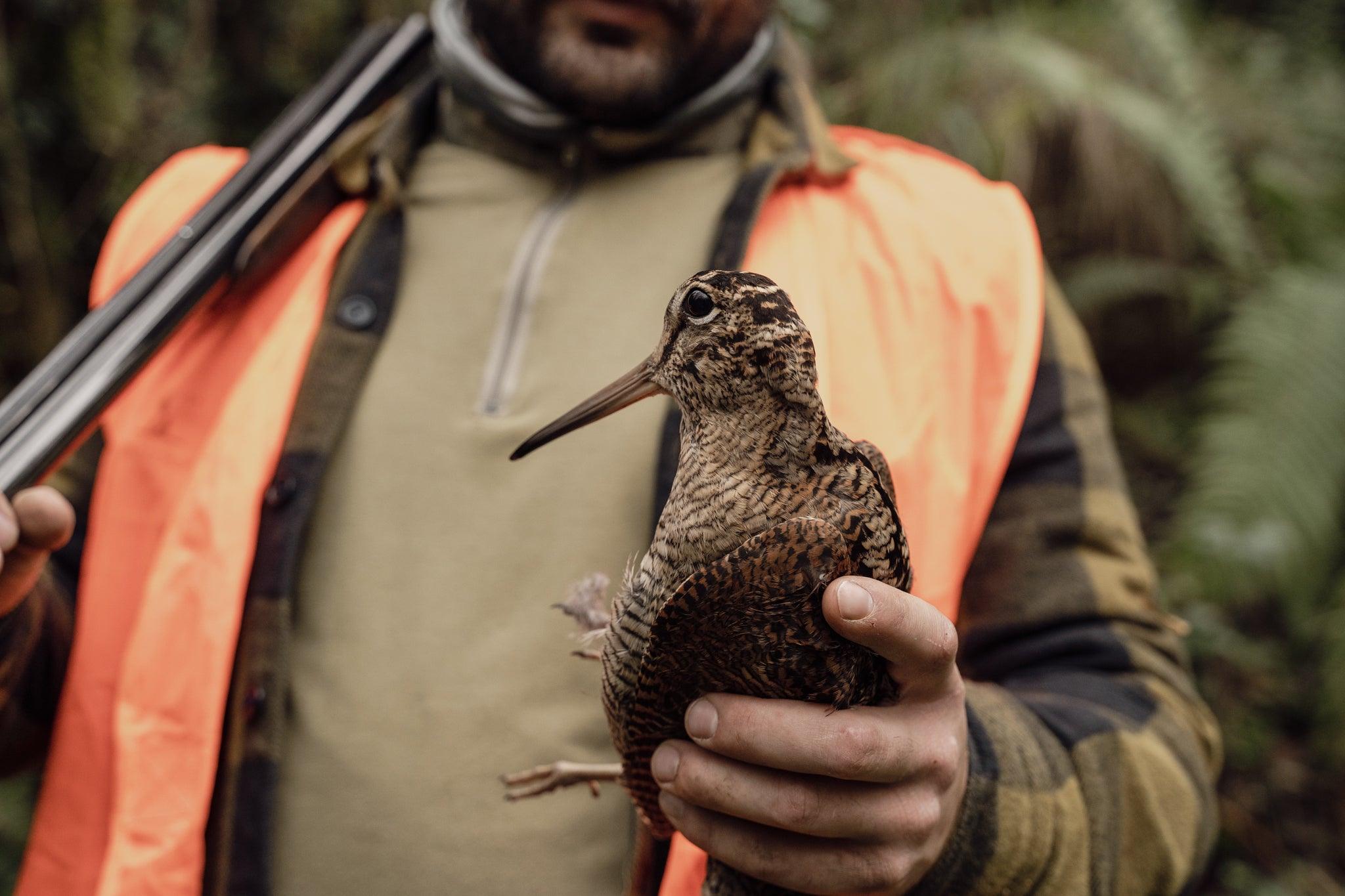
Sus principales características son su pico largo y puntiagudo y sus grandes ojos negros colocados muy atrás a los lados de su cabeza. Estos ojos son los que le confieren una gran visión de 360º, cualidad que lo convierte en un auténtico reto de caza. Pesa alrededor de 300 gramos y tiene un tamaño mediano de unos 30 centímetros. No tiene dimorfismo sexual, lo que significa que no hay diferencias de apariencia entre machos y hembras.
Its plumage is mottled brown, with reddish tones in different shades, which makes it a good camouflage in the leaf litter. All these qualities make it elusive and mysterious, a real challenge for any hunting enthusiast.

Behaviour and location
Due to its wild and mysterious behaviour, the woodcock is called "lady of the forest" and is for many the jewel of small game hunting. It is a migratory animal that has a tendency to return to its birth or wintering grounds. They stay for the winter season if the places are suitable, welcoming and, above all, if they have plenty of food. Woodcock stick their beaks into the soft ground and capture larvae and earthworms, which are the basis of their diet (although they also feed on seeds).
In Spain it can be found mainly in the wooded areas of the north, and can even be present in leafy central forests such as pine, chestnut, fir and holm oak woods. Its ideal environment is where there is a lot of lush vegetation and soft soil with a high humus layer. If there is a meadow in the vicinity with cattle, it is very likely to be found there or in the surrounding area.

Hunting the "lady of the forest"
It is a bird that arouses passions because of its difficulty and generates beautiful sets. It is a real challenge, with adverse weather conditions and difficult terrain. The best season to catch them is from October to February and you can find them in different places depending on the weather:
On cold winter days, they are located where the first rays of sunlight shine and where they are sheltered from the wind.
On cooler days they can be seen frequenting the banks of rivers and streams.
If there has been a fire, it is easy to find them looking for worms in rotting wood.
It is an extremely skittish bird which, if chased away "without making too much noise", will return to the same place. Knowing this behavioural trait, when we have found an area with woodcock that we have missed (because we missed the shot or because we were caught unawares) we will return to the same place an hour later.
We will approach with care, as, being restless, she will get up at the first opportunity or run to get up again out of shot. We must take the reference and enter slowly, so that when it starts to fly we can see it for as long as possible and thus be able to shoot with a guarantee of success.

Walking dogs
Although it requires a great effort to hunt them, the dog is the real protagonist of this capture. At first they are usually pointers such as English setters, but any breed will do as long as it is well disturbed.
The pointing dog has to know how to hold the game without picking it up until the hunter arrives. The hunters, as these are very leafy areas with little visibility, usually put a bell on the dog, so that when it stops ringing, it is known that it is on show. The retrieve, on the other hand, has to be exceptional, not leaving a piece to be retrieved, no matter how wounded it may be.
A woodcock dog must have a great passion for hunting, as he has to face rough terrain with a lot of courage. It must be a dog with a great sense of smell and the ability to find the mimetised bird.

Field trial
On this occasion, Asturias was the terrain where we had the opportunity to enjoy this hunt. And as you well know, it is not an easy terrain... brambles and mud making our steps a challenge.
This time, our friends from Solognac were more foresighted than us, knowing that they are very knowledgeable about the terrain, and brought us their wellington boots.
In this situation, there is no Goretex that can withstand. These boots were indispensable during the 2 days of hunting to keep us dry and in perfect condition to continue hunting.

From the forest to the table
Once the day is over, it is time to enjoy them and their great flavour. One of its peculiarities is that it is one of the few birds that is cooked whole, without discarding anything. It is a delicious species and one of the seasonal dishes with the best nutritional properties. Below we will show you the easiest and most traditional way to cook your roast woodcock:
Ingredients:
4 whole woodcock, plucked up to the very head and not gutted.
fine salt
3 tablespoons of butter soups
2 cloves of garlic
100 g of foie gras terrine
4 thin slices of toasted brown bread
preparation
Cut the woodcock from wings to legs, leaving only the longest toe.
Burn any remaining down with a flame and tie tightly with brides.
Salt them to taste.
Put them in the pan with 2 tablespoons of butter and the 2 cloves of garlic.
Brown them over a high heat, basting them in their own fat for 5 minutes.
Remove from the heat and leave to stand for a few minutes.
Remove the pan from the heat and set aside with the fat and juices inside.
Separate the breasts and legs, cut the necks off the heads and split the heads in two along the direction of the beak.
Place the woodcock on a rectangular plate on one side of the fire to keep them warm.
Place the carcasses in the oven (200°C) and leave for about 5 minutes.
After 5 minutes, take them out and scoop out the inside with a spoon, mixing it with the foie gras terrine.
Pasar esta pasta por un colador fino y extenderla sobre las tostadas de pan integral oblongas y finas, como si fueran tostadas.
Regrese la sartén baja al fuego con la cucharada restante de mantequilla.
Ponga la becada tallada en el lado de la piel y las cabezas en dos mitades en el lado plano.
Rocíelos constantemente con la grasa, usando una cuchara, hasta que estén dorados y no demasiado cocidos.
Escúrralos, sazónelos con sal y colóquelos en platos calientes, junto con las tostadas previamente untadas. Servir.

Autora: María Balletbó